All Andrew's Plants has moved to AllAndrewsPlants.wordpress.com
You can find this post here on my new site for the full post and to leave comments.
Cryptocoryne is a genus of some 50-60-ish species of semi-aquatic aroid from south east Asia, ranging from India to Papua New Guinea north to south west China.
Wild growing conditions range from hard water (
C. crispatula var. balansae) to black-water (
C. yujii) to brackish (
C. ciliata). Generally they grow in water or on the banks of well shaded streams (many are seasonally flooded then I presume flowering during the start(?) of the dry season). The range of each species is small, and the different forms of many species may only have a single collection point making some species and some forms very rare, on top of which many are very tricky to keep alive or growing well.
I personally keep mainly
Cryptocorynes which are common, easy, tolerant of hard water and apparently mostly from Sri Lanka (which are less likely to absolutely require a dry or dormant period the way some of the more northern species).
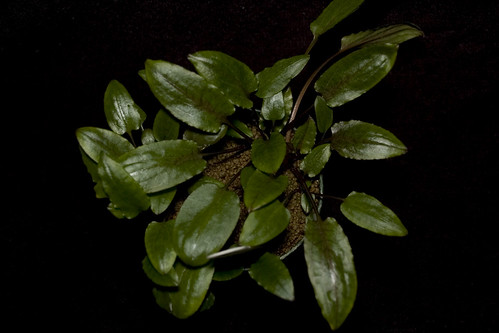
Cryptocoryne wendtii - Native to Sri Lanka,
C. wendtii is able to tolerate a range of water pH and low light. It is a very common aquarium plant, and for good reason. As an aquarium plant it can grow well in fairly low light with no supplemental CO2 and will be happy given a nutritious substrate where it will grow, and spread, and grow some more. Highly variable it also comes in green, brown, red, broad or narrow leafed forms with or without markings or an undulated margin. In brighter light they may be more more compact and colourful than those grown in low light, which will be larger but may still retain some colour.
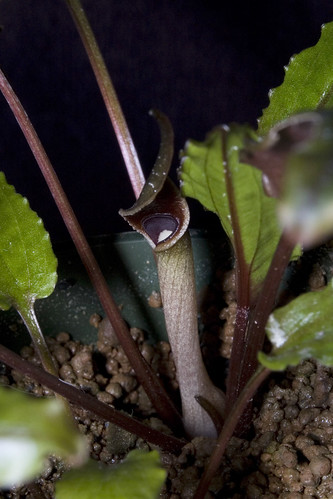
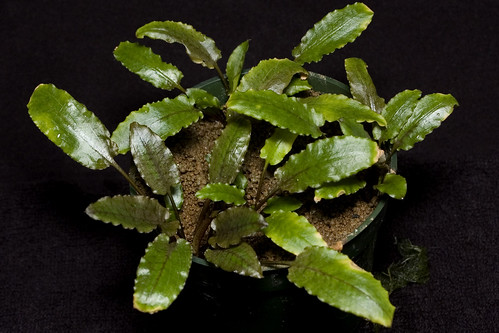
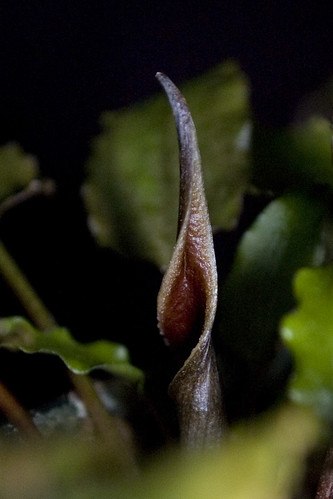
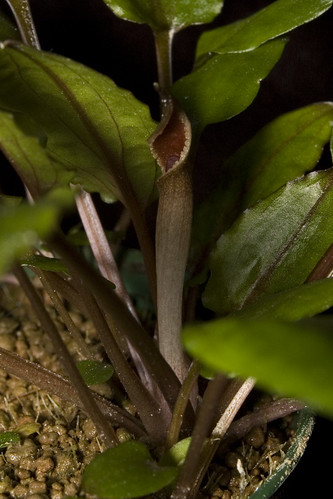
C. wendtii inflorescence and full plant shot.
I keep 4 or 5 different forms of
C. wendtii - two of which have flowered for me in emersed culture (flowers are extremely rare submerged though other species such as
C. crispatula have developed elongated spathes so they can flower underwater, they are an exception). A third I have just planted in emersed culture and a fourth I only have in submerged. Then there are a few small plants I need to grow out so I can compare them and see if they are the same as what I already have or if I still have a fifth variety, 'Tropica,' which was really nice but I couldn't ID one in my collection right now (it's possible the one I've just planted emersed is 'Tropica' - that would be a nice surprise).
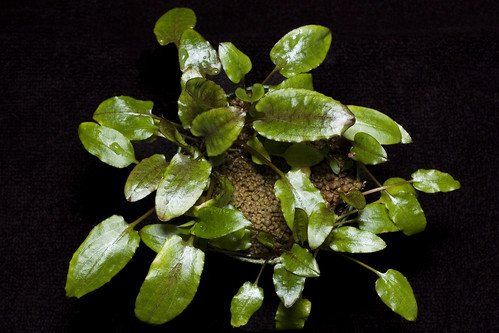
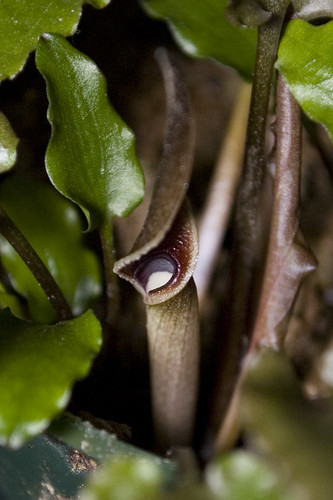
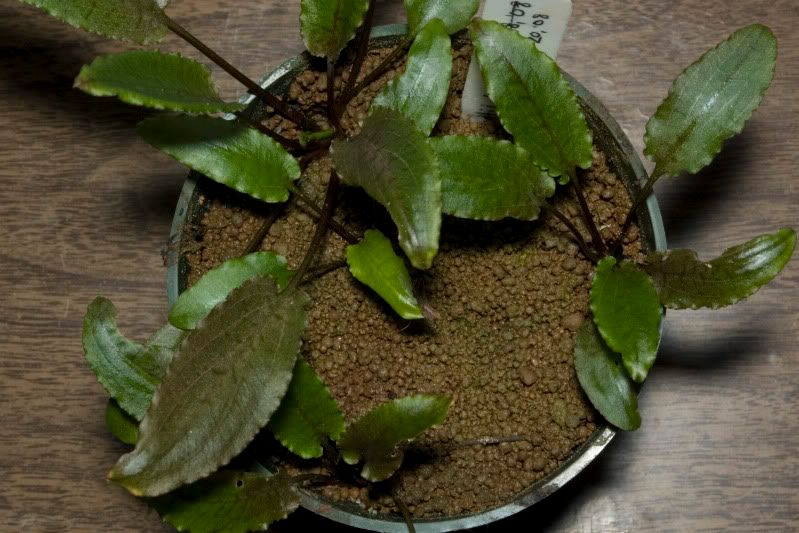
Another C. wendtii, this one flowered too but it's my favourite for foliage right now. It responded amazingly well to the addition of fertilizer a few weeks back.
C. x willisii is another Crypt you'll find in aquarium stores regularly. I haven't found it too easy in my low tech aquarium but it grows great for me emersed. I grow the regular one and
C. x willisii 'Lucens' (probably, might also be
C. walkeri 'lutea' but I doubt it, will technically have to get an inflorescence to be 100% sure though - it fails to grow submerged for me just like my other willisii...).
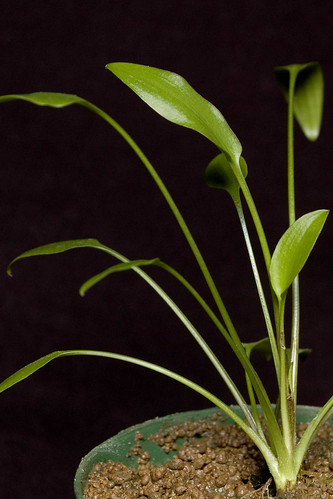
C. x willisii
C. x willisii used to be sold as
C. nevillii though that is technically a different species which had been lost to cultivation (but has been found again).
C. x willisii 'Lucens' used to be C. lucens but was reclassified. You'll still find
C. nevillii and
C. lucens for sale though.
C. undulata is another from Sri Lanka I grow. It did alright submerged for me but took off when I moved it into emersed culture by actually putting out runners. It basically looks like a large wendtii but the the petiole of any mature leaf being about the size of a full plant of wendtii that I have. Petioles are also a nice reddish colour. This one used to be called
C. willisii but isn't anymore (isn't this a fun genus to try and sort out an ID? Flowers are basically a sure thing but they're not the easiest to flower).
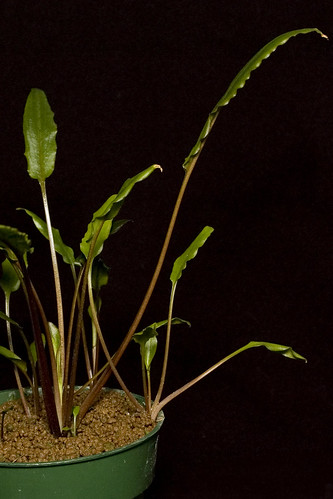
C. undulata. The plant grew but not fast for months submerged for me but only after moving it into emersed culture did it start sending off runners. It's starting to look like a pretty full pot now.
C. crispatula (var.
balansae most likely) is nice. My plants are young and small but it's growing fairly well. Leaves are long and narrow and heavily bullated. I'm only growing this submerged right now and haven't had it long enough to really comment on. Grows native in Thailand in calcareous environments, which makes it a good one to try if you have hard water.
C. pontederiifolia (from Sumatra) rounds out my collection. This is a fantastic plant that I wish grew better for me. It is pretty much the opposite in looks to
C. crispatula with smooth leaves that are about half as wide as they are long. It is growing much better for me emersed now that I'm fertilizing it more (though still only keeps a few leaves at a time, though these are increasing in size so something must be right) and is starting to grow well submerged but still has some problems and is definitely smaller than it could be. Some specimens can get a pink colour to the underside of the leaves but this seems to be as much environmental as anything else. Mine showed this trait when I got it but have since lost the colour.
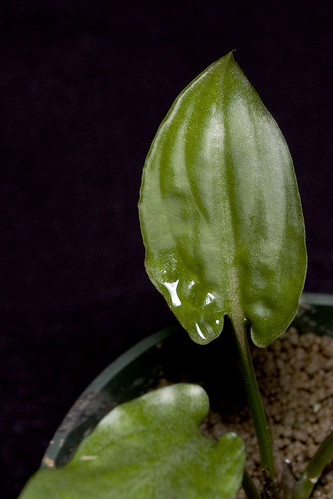
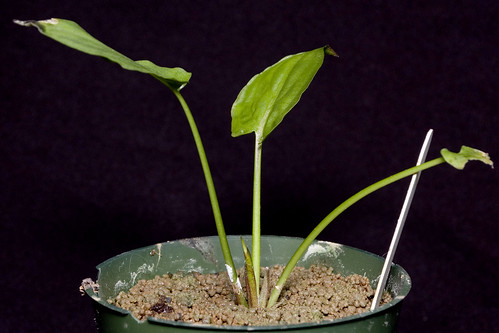
C. pontederiifolia - you can see one leaf is just about toast, one is starting to go, one just opened a few days ago and a new one is starting to come up. By the time it's up the oldest will be gone and the second oldest will almost be gone, but a new one should be starting again. Basically, the plant always looks like this.
I grow mine two ways that I touched on briefly above - submerged and emersed.
Submerged refers to either in my 5' 65 gallon aquarium or my 15 gallon plant only tank. In the 65 the substrate is playsand/florite mix (mostly sand) with a less than plant friendly fish (
Heros sp. "Rotkeil") who will either eat plants or if they aren't tasty he'll try to uproot them. Light is low with only a standard 4' two bulb shoplight, minimal fertilizers other than from fishfood and no CO2 injection (I'm happy with this mix because I have next to no algae growth). The 15 gallon does not have any fish or lights really (over spill from my 20 gallon terrarium), plants are potted in clay pots in Red Sea FloraBase but don't get much fertilizer at the moment. (I may have to shut down this tank when I get my seeds, maybe I'll go with a single 5 gallon tank, another 5 gallon tank for my seeds and a 4' shoplight over my 20gal and the two 5s...)
Submersed culture is fairly simple for the species I grow - put them in water and be patient, put them in better water and wait less time for results. Be prepared for your crytps to melt when added or if anything is changes in terms of water chemistry - just leave the rhizome & roots where they are and they'll resprout. Crytps are excellent at figuring out what size, colour and thickness of leaves they need and will produce exactly what they need for any given situation.

C. x timahensis with spathes in situ. This is thought to be a natural hybrid of C. nurii and C. cordata is found in only one pond in Singapore. These plants are growing in water 25cm deep in soft mud in soft, slightly acidic water.
(photo by Jan D. Bastmeijer used under CC license from here & here)
Emersed plants are in my 20 gallon terrarium where plants are in Red Sea Florabase in plastic pots sitting in the same strength nutrient solution as I use for my S/H orchids under medium-low light. (I also have a shelf built out of "eggcrate" fluorescent light diffuser where I grow my
Miltonia NOID backbulb, and on the background I have my
Tillandsia collection, and on the back wall is my
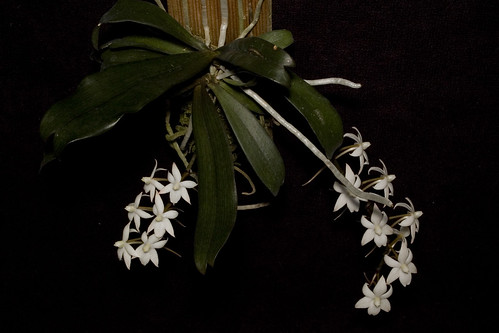
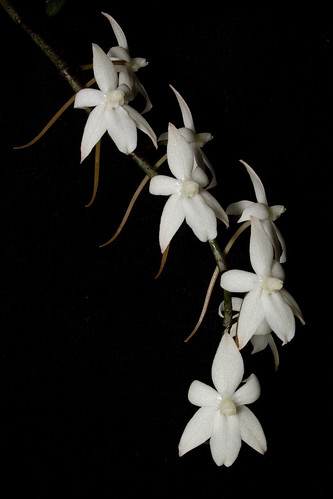
Aerangis biloba - My terrarium is asking me to be upgraded in terms of size, lighting, more eggcrate, better baskets for
Tillandsias and possibly a section where I can grow submersed crypts as well) The terrarium is covered by something that isn't very tight, meaning that humidity is less than 80% basically at all times (which I need for my orchids). Sometimes very first thing in the morning I'll see some condensation on the glass but not much and it goes away fast.
Cryptocorynes grown emersed are often grown in close to 100% humidity but I prefer the effect of the lower humidity.
As mentioned above crypts melt, fairly often the way some people tell it. They then grow leaves suitable for their growing conditions. In my low humidity they develop thick glossy leaves that look fantastic and hold up well when taken out of the terrarium for picture day. Under high humidity they may not even lose their old leaves (or they will last a much longer amount of time) and will continue to grow thin leaves. These take less energy for the plant and they may grow better and faster that way but they'll wilt and dry out with a drop in humidity much faster than my plants. That said, my results are also not as good as what many people with higher humidity are seeing... so take from that what you will! Some of the nicest plants I've seen were growing in open air in a humid greenhouse, and of course I've lost the link...
Here's a shot (the the one I was looking for) at the US Botanical Garden conservatory palm house in Washington, DC that shows some really nice looking growth.
I also don't get many flowers from my crypts. That may be related to my low humidity, former low nutrient levels &/or the age of my plants. The two of mine which have flowered had been growing two years emersed before flowering. Not many people do get flowers, the flowers are not terribly exciting, don't last long and smell pretty bad, so I don't feel so bad but it is a nice accomplishment.

C. x timahensis in situ. This pond is the only known locality for the plant, where they grow on both sides of the dam. As a hybrid C. x timahensis is sterile and does not produce fruit. Oddly enough, though this species has such a small natural habitat neither of the suspected parents are found in Singapore, both are native to a nearby area in Malaysia.
(photo by name used under CC license from here)
Problem with where I am now with my collection is that the plants I have are all common, and I have almost all the common plants (I'm missing a
C. spiralis &
C. cordata or two) and that the uncommon plants are... uncommon. Especially in Canada. The leap in difficulty in growing the plants I have now to the ones I want eventually is at first not too bad with plants such as
C. cordata, C. nurii, etc. which need slightly acidic water. Not terribly difficult but it does mean a new terrarium. As I start to get into black-water plants we're looking at trying to get water with a pH less than 5.5 ideally, and that's not easy. Definitely impossible with my tap water and I don't know I'm hooked enough on crypts to justify buying them water. I will likely end up with one tank for hard water crypts and one for softer water, slightly acidic species and basically ignore the black-water species than can't tolerate the slightly acidic conditions of the one tank.
The other problem I suppose is that I don't have much space. Where a lot of plants can sort of be stuck anywhere these absolutely need either a terrarium or an aquarium. No other options for me other than more or larger tanks. I'd ideally like to go with a larger tank (maybe with different sections for hard/soft water but lots of space up top for Tillandsias and Orchids) but not right now.
In short:
Crypts - they're awesome.
Species from Sri Lanka are generally easy, especially
C. wendtii.
Grow them submerged or emersed.
Either way they want good soil.
Flowers are rare, rarer submerged.
Low light is ok. For the most part they grow in shaded streams with trees overhead.
Some Crypts tolerate hard water. Most will take slightly soft water. Some need black-water.
If you can grow them in fairly soft water around a pH of 6.5 you can keep probably 80-90% of species.